
The State of the Judiciary
Rising Workload & Capacity Conundrums
Introduction
At the end of 2024, a persistent lack of capacity hindered justice delivery. Court hall shortages stayed around 15 per cent against sanctioned strength of judges. Judicial spending rose slightly. Subordinate courts improved clearance rates, while high courts’ clearance rates declined. Gender diversity showed a slow but positive rise.
The number of pending cases at the end of 2024 reached 5 crores, up nearly 20 per cent since 2020. Meanwhile, judge vacancies in high courts and district courts changed little and continue to hover around 33 per cent and 21 per cent, respectively. As of January 2025, over half of cases in both high and district courts had been pending for more than three years.
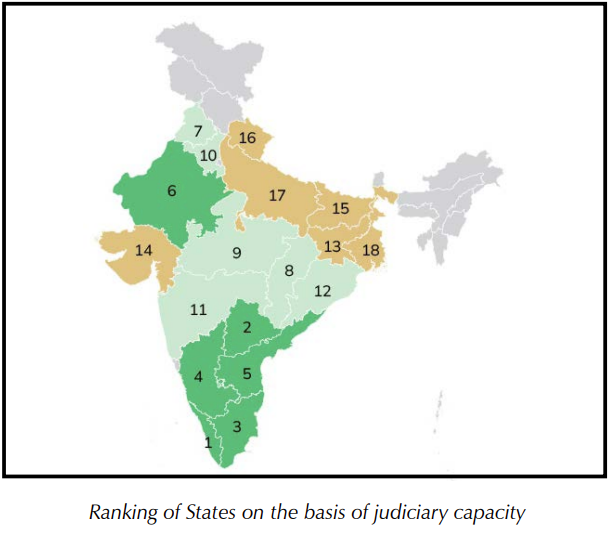
Some states recorded significant improvements. Andhra Pradesh rose seven places from eleventh. Rajasthan had the biggest upward jump from seventeenth (2022) to sixth—driven by higher per capita spending, reduced High Court vacancies, better population-per-judge ratios, and stronger clearances.
Human Resources
In January 2025, India had 21,285 sitting judges across all courts, including the Supreme Court. That’s an increase since 2022, but still well below the officially approved total of 26,927 posts. Based on population projections of March 2025, there are currently 15 judges for every 10 lakh people. Even if the sanctioned strength were met, there would still only be 19 judges per 10 lakh people – well below the 1987 Law Commission recommendation of 50 judges per 10 lakh people.
High Courts: Between 2016-17 and 2025, the overall sanctioned strength of high court judges fell from 1,136 to 1,122. Vacancies have fallen over time from about two in five posts to roughly one in three. In 2025, 16 out of 25 high courts had one in four judges missing. Allahabad reported 51 per cent vacancies – the highest amongst all states.
High Court Staff: Staff vacancies remain largely unchanged, averaging around 25 per cent. In 2025, 13 high courts recorded staff vacancies between 20 per cent and just under 50 per cent. Only Andhra Pradesh saw a major reduction –from 51 per cent in 2022 to 18 per cent in 2025 – after setting up its new High Court in 2019.
Subordinate Courts: The vast majority of cases begin and end at the lower courts. Yet, the sanctioned strength stands at 25,771 – an average of 18 judges per 10 lakh population. Between 2022 and 2025, 17 states/UTs reduced their district judge vacancies; 12 saw an increase; six remained unchanged.
Infrastructure
Among the large states, Haryana and Chhattisgarh had a deficit of one in every four court halls. Between 2022 and 2025, 19 states/ UTs reduced the gap between sanctioned strength and the required court halls, with Meghalaya and Arunachal Pradesh showing significant improvements. Conversely, 11 states/UTs still face deficits of over 25 per cent, and only three states and one UT have sufficient court halls in 2025.
Diversity
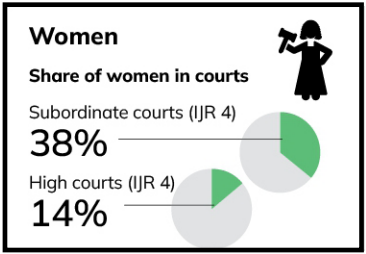
Gender Diversity: Women constitute 37.4 per cent of all judges. Their presence was stronger in the lower courts (38%) than in the high courts (14%). Of the 21,253 judges at the high and district courts, just under 8,000 are women - 106 in the high courts and 7,852 at district courts. The high courts of Meghalaya, Tripura, and Uttarakhand recorded no women on their benches, but register a high share of women in their subordinate courts.
Nagaland improved the most from 20 per cent to 63 per cent, followed by Mizoram (21% to 51%) and Arunachal Pradesh (0% to 33%). Among the large states, Rajasthan (27% to 42%) and Bihar (12% to 27%) show the most improvement. The subordinate courts of the Andaman and Nicobar Islands and Dadra & Nagar Haveli and Daman & Diu are the only jurisdictions that record no women judges.
Caste Diversity:
Data on caste representation in high courts is limited, but parliamentary records show that of nearly 700 judges appointed since 2018, only a small share came from Scheduled Castes (22), Scheduled Tribes (15), Other Backward Classes (87), and minority communities (37). Telangana met its quotas for OBCs and STs, while states like Ladakh (588%), Chandigarh (148%), Andhra Pradesh (111%), Karnataka (110%), and Assam (100%) exceeded their SC quotas.
Workload
Despite repeated recommendations over decades – from the Law Commission in 1958, 1987, and 2009, and a Supreme Court study in 2016 – case backlogs remain severe. Of the 5.1 crore cases pending across high courts and district courts in January 2025, 12 per cent have been pending for more than 10 years and 22 per cent for five to 10 years. On an average, 61 per cent of high court cases and 46 per cent of district court cases have been pending for more than three years. An additional 82,000 matters are pending in the Supreme Court.
Uttar Pradesh records 4.5 lakh cases pending for more than 10 years, followed by Maharashtra (1.7 lakh) and Madhya Pradesh (1.4 lakh). In all high courts, with the exception of Karnataka, Manipur, Meghalaya, Sikkim, and Tripura, one in two matters has been pending for more than three years; in the Allahabad High Court, this applies to 71 per cent of all matters.
In district courts of 26 states/UTs, one in three cases has been pending for more than three years, with Bihar recording the highest proportion at 71 per cent. Seven states and UTs have more than 10 per cent matters pending for more than 10 years. Bihar (22%) and West Bengal (20%) also had the largest share of cases pending for over 10 years.
Case Clearance Rates: A case clearance rate (CCR) of more than 100 per cent reduces backlog. Nationally high courts averaged a CCR of 94 per cent in 2024. Ten high courts cleared more cases than they received, with Jharkhand, Tripura, Punjab & Haryana, Madras, Telangana, Odisha and West Bengal, achieving this feat for three years in a row. Between 2020 and 2024, 15 high courts steadily improved their CCRs, especially Andhra Pradesh and Telangana. However, CCRs declined in 11 high courts, with Manipur and Sikkim showing the sharpest falls.
NEXT »


