
States of Compliance
Analysing State-wise Compliance of the Judgement
Vinson Prakash*
Imagine a police officer who wants to do the right thing – refuses to file a false case, resists a minister’s call to let someone go, or investigates a crime that implicates a powerful politician. In most parts of India, that officer will be transferred within days, quietly reassigned to some distant post. The message is unmistakable: fall in line, or suffer.
This is not a new problem. In 1902, the Fraser Commission found the police to be corrupt, inefficient, and oppressive. The Dharma Vira Commission in 1977 noted that the public saw the police as politically partisan, partial, and corrupt. More than a century later, the same words keep appearing in people’s voices and newspaper headlines: Custodial torture and death; bribed officers; charges against politicians vanishing.
In 2006, the Supreme Court decided it had waited long enough. In the landmark case of Prakash Singh vs. Union of India, frustrated by decades of unfulfilled promises and ignored recommendations, the Court issued seven specific, binding directives to States and the Centre. These were Court orders, designed to insulate the police from political interference, make them accountable to the public, and modernise how policing works in a constitutional democracy.
20 years later, Is anyone listening?
The short answer is: barely.
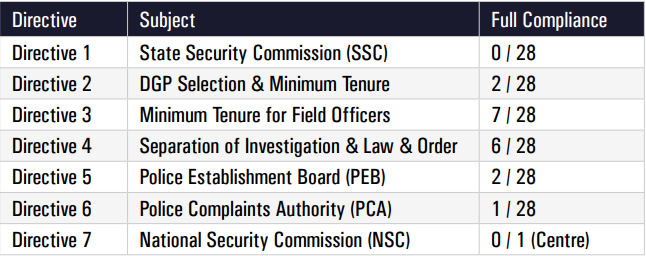
Not a single State or Union Territory is fully compliant across all seven directives(CHRI, 2021). Most States have done the bare minimum, such as setting up the required bodies on paper while quietly hollowing them out so that they can’t actually do anything.
This article walks through each directive, looks at what the states were asked to do, what was done, and what that means for ordinary people across the country.
Directive 1: State Security Commission
What’s the Court’s Intention?
One of the major issues plaguing the Indian police is that politicians can and routinely do interfere in how the police work – who gets posted where; which cases actually get investigated; who gets arrested and who doesn’t. The State Security Commission (SSC) was the Court’s answer to this: an independent body that would set broad policing policy, evaluate police performance, and hold the government accountable through an annual report placed before the State legislature. The Commission should include the Leader of the Opposition and several independent members selected through a transparent process.
Table 1: State Compliance Across all Seven Directives
What did States actually do?
Twenty-seven out of the 28 states have constituted the SSC on paper, with Odisha being the exception. But setting up the Commission is as far as most States have gone (CHRI, 2019). Full compliance requires five things: forming the SSC; including the Leader of the Opposition; having three or more independent members; making the SSC’s recommendations binding on the government; and producing annual reports for the legislature. Karnataka is the only State that comes close, and even it is only partially compliant (CHRI, 2021).
Seven states – Assam, Bihar, Chhattisgarh, Gujarat, Punjab, Telangana, and Tripura –have not included the Leader of the Opposition in the SSC, which is the most basic requirement. Seventeen states have independent members but let the government pick them directly, without any independent selection process, defeating the entire purpose. Bihar, Goa, and Tamil Nadu don’t include any independent members, making the SSC a purely governmental body (CHRI, 2021).
Most critically, Karnataka is the only State to have made the SSC’s recommendations binding on the government. In the remaining 26 states, the SSC is just an advisory body, a talking shop that the government is free to ignore entirely. Its meetings are irregular, often no decisions are taken, and when they are, they are not implemented owing to their non-binding status (CHRI, 2019).
What does this mean in practice? It means political interference continues unchecked. When governments can ignore the SSC, and even better, appoint their own patrons to head it, there is little to no hope for reforms from the SSC to ever see the light of day.
Directive 2: Selection and Tenure of the DGP
What’s the Court’s Intention?
The Director General of Police (DGP) is the most powerful officer in a state’s police force. The Court wanted to break the government’s chokehold over this appointment by requiring that the DGP be selected from among the three most senior eligible officers, as shortlisted by the UPSC, based on merit. Once appointed, the DGP must serve a minimum two-year tenure, and can only be removed early on specific, documented grounds, in consultation with the SSC.
What did States actually do?
Only two states – Arunachal Pradesh and Nagaland – are fully compliant. Tamil Nadu and Andhra Pradesh partially comply (they follow the shortlisting and tenure requirements, but not the removal process). That leaves 24 States non-compliant, with more than 20 of them bypassing both the UPSC shortlisting and the guaranteed tenure altogether (CHRI, 2021).
What does this mean? By skipping the UPSC process, governments can handpick their preferred DGP. Without a protected tenure, they can remove the DGP on vague “administrative” or “public interest” grounds the moment that officer does not nod in agreement. A DGP who owes their position to political patronage is unlikely to refuse when that same politician calls to ask for a favour – a transfer here, a case dropped there, or a protest stomped down tomorrow.
Studies have consistently shown that frequent transfers damage police efficiency, erode community relationships built over time, destroy institutional knowledge of local crime patterns and devastate officer morale
The resulting instability at the top of the force has consequences all the way down the hierarchy. Leadership changes frequently, officers know the files that need to collect dust, and the partisan policing cycle perpetuates itself.
Directive 3: Minimum Tenure for Key Field Officers
What’s the Court’s Intention?
Arbitrary transfers are the most common weapon used against police officers who resist political pressure. An Inspector General (IG), Deputy Inspectors General (DIG), Superintendent of Police (SP), or a Station House Officer (SHO) who refuse to “fall in line” can find themselves transferred overnight to some far-off, inconsequential post. The Court mandated a minimum two-year tenure for these key field officers. Early removal is only permitted for disciplinary reasons, conviction, or incapacity.
The most common ways States have gutted the PEB are: including government officials as members; stripping its power to actually decide transfers and postings; and refusing to let it function as an appeal body.
What did States actually do?
Seven states – Andhra Pradesh, Arunachal Pradesh, Gujarat, Kerala, Madhya Pradesh, Mizoram, and Nagaland – are fully compliant, and 16 states provide for a minimum two-year tenure in law. But the directive requires both the tenure guarantee and adherence to the Court-prescribed removal procedure. Counting only States that do both, 21 States are still non-compliant (CHRI, 2021).
Studies have consistently shown that frequent transfers damage police efficiency, erode community relationships built over time, destroy institutional knowledge of local crime patterns and devastate officer morale (Sahni et. al., n.d). Investigations stall, cases go cold, and the underlying message to every officer watching is clear: doing your job well is less important than staying on the right side of the right people.
Directive 4: Separating Investigation From Law & Order
What’s the Court’s Intention?
Ask most police officers what their day looks like, and you will find they are doing two completely different jobs simultaneously: managing crowds, handling VIP security, and maintaining public order on one hand, and investigating crimes on the other. These roles require very different skills, mindsets, and time commitments. The Court directed States to separate these functions in urban areas with population over 10 lakhs, then gradually roll out the separation to smaller towns.
What did States actually do?
As of 2022, only six States – Tamil Nadu, Karnataka, Himachal Pradesh, Madhya Pradesh, Maharashtra, and Punjab – have reported full compliance. Six States report partial implementation, and seven others have accepted the guidelines in principle but taken no action (IJR 2022).
The main obstacle is one that States could fix if they chose to: chronic understaffing. India’s actual police strength is over twenty percent, lower than the sanctioned strength (IJR, 2025). When a police station does not have enough officers to split into two teams, the directive becomes functionally impossible. A failure to implement this directive has potentially far-reaching consequences – low conviction rates, rushed investigations, and an overcrowded undertrial population in prisons. People who have not been convicted of anything wait years for a system that is stretched too thin to process their cases.
Directive 5: Police Establishment Board
What’s the Court’s Intention?
Transfers and postings are political currency in India. A government that controls where officers are posted controls what those officers will and won’t do. The Police Establishment Board (PEB) was designed to take that control away from the politicians and hand it back to the police. The PEB was to be chaired by the DGP and four other senior officers, and decide on all transfers, postings, and promotions for officers up to the rank of DySP, and make recommendations on the same for ranks above that. Government interference should happen only in exceptional cases, in writing, with stated reasons. The PEB also functions as an appeal forum for officers facing illegal orders or grievances with their promotions, transfers, or disciplinary proceedings.
What did States actually do?
All States except Telangana have established PEBs on paper, but only Arunachal Pradesh and Karnataka are fully compliant with the directive. Five more States – Andhra Pradesh, Jharkhand, Manipur, Madhya Pradesh, and Uttarakhand – follow most of the parameters but do not allow the PEB to function as an appeal forum. That leaves 20 states non-compliant (CHRI, 2021).
The most common ways States have gutted the PEB are: including government officials as members; stripping its power to actually decide transfers and postings; and refusing to let it function as an appeal body
The compounding effect here is significant. If a State is also non-compliant with Directive 2, meaning the DGP was handpicked by politicians, then that DGP also sits atop a PEB that serves political interests. The entire chain of command, from the DGP down, ends up beholden to whoever is in power. The Court’s vision of a self-governing police administration becomes a polite fiction.
Directive 6: Police Complaints Authority
What’s the Court’s Intention?
If a police officer beats you in custody, extorts you, or abuses their authority – where do you go? For most Indians, the answer is: nowhere useful. Sure, one can say there are independent Human Rights Commissions at both the State and National levels. But when not one police officer since 2005 has been found guilty in over 500 cases of custodial deaths, doubts emerge over the independence and reliability of these commissions. Moreover, SHRCs, ever since their inception, have always been chronically underfunded, understaffed, and have depended on the police for investigations.
Moreover, filing a complaint with the police about the police has obvious problems. The Court mandated independent Police Complaints Authorities at both the State and district levels, empowered to investigate serious misconduct, including custodial death, grievous hurt, rape, extortion, and abuse of authority. Crucially, their recommendations were to be binding. They were to be headed by retired judges and staffed with independent members selected through a transparent process.
A complaints authority dominated by the government and serving police officers, no independent investigation, and no binding recommendations is the perfect recipe for a noaccountability mechanism.
What did States actually do?
Twenty-three States have established State-level PCAs, and 18 have district-level PCAs. Fifteen States have both. That sounds reasonable until you look at what these bodies actually look like. Himachal Pradesh and Odisha have simply assigned the job to the state Lokayukta, sidestepping the establishment of an independent, dedicated PCA (CHRI, 2021). Tamil Nadu’s PCA is headed by the Home Secretary and includes serving police officers as members, creating the extraordinary situation of the accused investigating themselves.
Only seven States – Arunachal Pradesh, Haryana, Karnataka, Kerala, Nagaland, Sikkim, and Uttarakhand – have proper criteria for selecting independent members of the state PCA. Everywhere else, the “independent” members are either ex officio government officials or directly appointed by the State government (CHRI, 2021).
At the district level, 11 States deviate from the requirement of a retired district judge heading the authority. Eight States have serving police officers as members of the body meant to investigate police misconduct. Gujarat, Kerala, and Tamil Nadu don’t include any civil society representative at all. Only Haryana and Tamil Nadu provide for independent investigators to assist the PCA in actually conducting inquiries (CHRI, 2021).
A complaints authority dominated by the government and serving police officers, no independent investigation, and no binding recommendations is the perfect recipe for a no-accountability mechanism. It is a way for perpetrators to manage complaints about themselves. This is perhaps the most troubling area of non-compliance because it directly affects the people who have been abused by the State and have no recourse.
Directive 7: National Security Commission
What’s the Court’s Intention?
This directive was aimed at the Centre rather than the States. The Court directed the establishment of a National Security Commission to recommend appointments for the heads of central police organisations – the CBI, NIA, and others – and to serve as an evaluative body to improve the effectiveness of these organisations. It was to be chaired by the Union Home Minister, with the Home Secretary as its secretary, and include heads of central police organisations and security experts.
What did States actually do?
On January 3, 2018, the Minister of State for Home Affairs disclosed in the Rajya Sabha that a body called the Committee on National Security and Central Police Personnel Welfare (CNS & CPPW) had been constituted in January 2017 to handle recommendations for DG-level appointments at the Centre. That’s all the information publicly available. The committee does not appear in any official listing of commissions or committees under the Ministry of Home Affairs. There is no publicly available information on its composition, functions, meetings, or any decisions it has taken.
The Prakash Singh judgment was not asking States to do anything radical. The resistance to even these basic reforms, sustained over 20 years of binding court orders, tells you everything about the political incentives at play.
Meanwhile, Directors of central police organisations like the CBI have been appointed as acting chiefs or have served tenures of less than two years – exactly what the directive was meant to prevent. The combination of opacity and non-compliance with the tenure requirement strongly suggests the CNS & CPPW exists only on paper, and the Central government has been no more compliant with this directive than the States it was meant to oversee.
Sweeping Under the Rug
Looking across all seven directives, one pattern is impossible to miss: at every level of government, the response to these reforms has been the same. Create the body, give it a name and a letterhead. Then quietly strip it of power, pack it with loyalists, and go back to business as usual.
States have not failed to comply because the reforms are technically difficult or administratively complex. The CHRI and other organisations have published detailed model laws and implementation guides. The what is not the problem. The problem is the why – and the why is simple: political control over the police is too valuable to give up.
Transfers, postings, appointments, and oversight are not just administrative mechanisms. In the hands of State governments, they are instruments of power. They reward loyalty, punish independence, and ensure the police remain responsive to whoever is in government rather than to the law or the public.
The Prakash Singh judgment was not asking States to do anything radical. It was asking them to implement recommendations that multiple commissions had been making since 1902. The resistance to even these basic reforms, sustained over 20 years of binding court orders, tells you everything about the political incentives at play.
The cost of this choice is borne by ordinary people – the citizen who files an FIR that goes nowhere; the undertrial who spends years in prison waiting for a trial that a better-resourced system would have concluded long ago; the person who died in custody and whose family cannot find a complaints authority that will actually investigate. Until governments at both levels genuinely commit to these reforms, rather than building elaborate facades of compliance that protect no one, the institution will remain unchanged. And people across this country will continue to fear the police rather than feel protected by them. References
- Commonwealth Human Rights Initiative (CHRI). (September 2021). Government Compliance with Supreme Court Directives on Police Reforms: An Assessment.
- Commonwealth Human Rights Initiative (CHRI). (2019). State Security Commission: A study of police oversight in India.
- India Justice Report 2022: Ranking States on Police, Judiciary, Prisons & Legal Aid.
- India Justice Report 2025: Ranking States on Police, Judiciary, Prisons & Legal Aid
- Prakash Singh & Ors. vs. Union of India & Ors., (2006) 8 SCC 1.
- Sahni, A., Jha, S. K., Ramana, P. V., Routray, B. P., & Roul, A. (n.d.). Project report on impact of frequency of transfers on efficiency and effectiveness of superintendents of police. South Asia Terrorism Portal. https://www.satp.org/satporgtp/icm/impact.htm
NEXT »


