
Reforming Labour or Recasting Labour Rights?
INDIA’S LABOUR CODES
Reforming Labour or Recasting Labour Rights?
Rishikesh Kumar*
When India became a founding member of the International Labour Organisation (ILO) in 1919, it committed itself to a simple yet enduring principle: economic progress must be accompanied by dignity at work. The story of labour reform in India did not begin with the Labour Codes. It has been shaped over decades by legislative interventions, workers’ struggles, and judicial pronouncements. Among the most significant was the Supreme Court’s decision in Air India Statutory Corporation v. United Labour Union, which underscored the principle that contract workers should not be denied fair wages and humane working conditions merely because of the nature of their employment. The judgment reflected a broader constitutional commitment to labour welfare and highlighted the need to prevent the exploitation of vulnerable workers. As India aspires to become a developed nation by 2047, that principle finds itself at the centre of one of the most consequential policy debates in independent India’s history.
By the second decade of the twenty-first century, India’s labour law framework had become a product of decades of incremental legislation. Industrial disputes, economic transitions, judicial interventions, and social movements had each added new layers to the regulatory landscape. While these laws were enacted to protect workers, the resulting framework was increasingly criticised as fragmented, complex, and poorly suited to emerging forms of employment such as gig and platform work. As India’s economy evolved, calls for a comprehensive restructuring of labour regulation grew stronger.
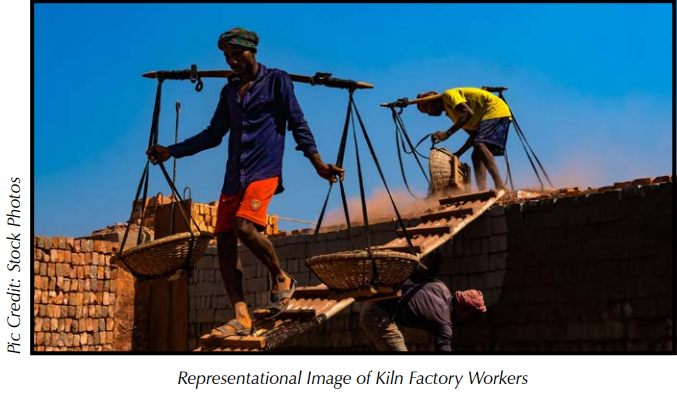
Against this backdrop, the Government of India undertook an ambitious legislative exercise, consolidating 29 labour laws into four comprehensive codes:
- the Code on Wages, 2019;
- the Industrial Relations Code, 2020;
- the Code on Social Security, 2020; and
- the Occupational Safety, Health and Working Conditions Code, 2020.
The Four Codes at a Glance:
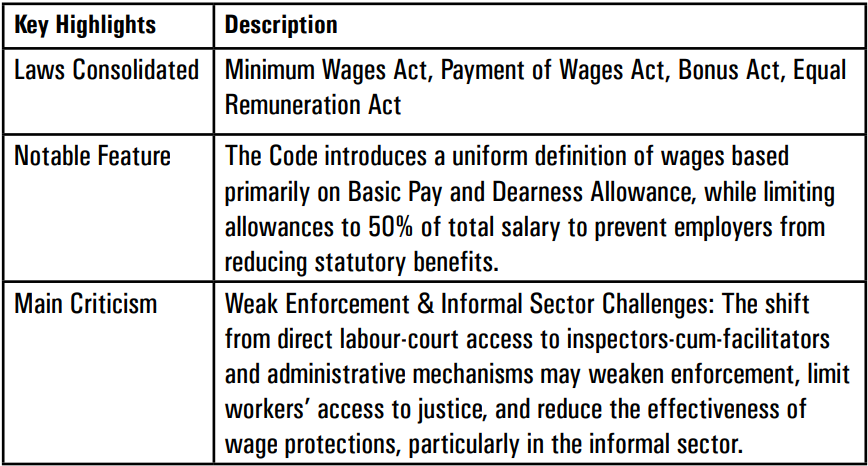
1. Code on Wages, 2019
The stated objective was to simplify compliance, improve ease of doing business, promote investment, and extend legal protections to emerging categories of workers, including those in the gig and platform economy.
Yet, beneath the promise of simplification lies a deeper question. Are the Labour Codes a long-overdue modernisation of India’s labour market, or do they signal a gradual shift in the balance of power from workers to employers? Supporters view the reforms as essential for economic growth and employment generation in an increasingly competitive global economy. Critics, including trade unions and labour rights advocates, argue that provisions relating to fixed-term employment, retrenchment, collective bargaining, and the right to strike may weaken worker protections in the name of flexibility.
The debate, therefore, is not merely about labour regulation. It is about the kind of development India seeks to pursue. Can economic flexibility coexist with social justice? Can labour markets become more competitive without making workers more vulnerable? This article critically examines India’s Labour Codes through these competing lenses, assessing whether the reforms strike an appropriate balance between efficiency, flexibility, and the constitutional promise of dignified work.
Expanding the Scope of Wage Protection
The Code on Wages consolidates four key wage-related legislations into a single framework and extends minimum wage protection beyond the earlier category of “scheduled employments.” By bringing a wider segment of workers within its ambit, the Code seeks to create a more inclusive and simplified wage regime.
Are the Labour Codes a longoverdue modernisation of India’s labour market, or do they signal a gradual shift in the balance of power from workers to employers?
Creating a Uniform Wage Framework
A major innovation of the Code is the introduction of a National Floor Wage, below which States cannot fix minimum wages. The Code also establishes a uniform definition of “wages”, reducing inconsistencies that existed across different labour laws and limiting the scope for employers to restructure salary components to avoid statutory obligations.
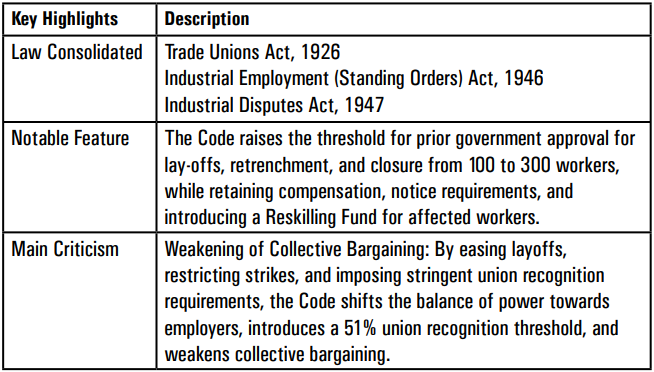
2. Industrial Relations Code, 2020
Concerns over Wage Determination and Enforcement
Despite these reforms, concerns remain regarding implementation and worker participation. The Code does not provide a robust mechanism for periodic revision of the National Floor Wage, raising questions about its ability to keep pace with inflation and rising living costs. Further, unlike ILO standards that emphasise tripartite consultation among governments, employers, and workers, the Code offers limited institutional safeguards for meaningful worker involvement in wage-setting decisions. Questions have also been raised regarding enforcement, as the shift towards inspectors-cum-facilitators and administrative mechanisms may reduce workers’ access to effective remedies, particularly in a labour market characterised by informality and unequal bargaining power.
Consolidating Industrial Relations Laws
The Industrial Relations Code consolidates three key labour legislations the Trade Unions Act, 1926, the Industrial Disputes Act, 1947, and the Industrial Employment (Standing Orders) Act, 1946 into a single framework governing trade unions, dispute resolution, layoffs, retrenchment, and closure of establishments.
Formalising Collective Bargaining
The Code introduces measures aimed at strengthening transparency and collective bargaining. Mandatory issuance of appointment letters formalises employment relationships and reduces ambiguity regarding workers’ rights and obligations. It also establishes a framework for recognising negotiating unions and negotiating councils, thereby providing a structured mechanism for collective bargaining.
Greater Flexibility, Growing Concerns
The most debated reform under the Code is the increase in the threshold for prior government approval for layoffs, retrenchment, and closure from 100 to 300 workers. While proponents argue that this reduces regulatory burdens and encourages firms to expand and hire, critics contend that it weakens job security for workers employed in medium-sized establishments. The Code also introduces fixed-term employment, granting workers parity in wages and benefits with permanent employees but allowing employers greater flexibility through non-renewal of contracts.
Restrictions on Collective Action
Concerns have also been raised regarding the Code’s impact on workers’ bargaining power. The requirement of prior notice for strikes and restrictions on industrial action during conciliation and arbitration proceedings are viewed by many as limiting the effective exercise of the right to strike. Critics argue that these provisions, coupled with easier retrenchment norms, tilt the balance in favour of employers and diverge from ILO standards that view collective bargaining and industrial action as essential components of freedom of association.
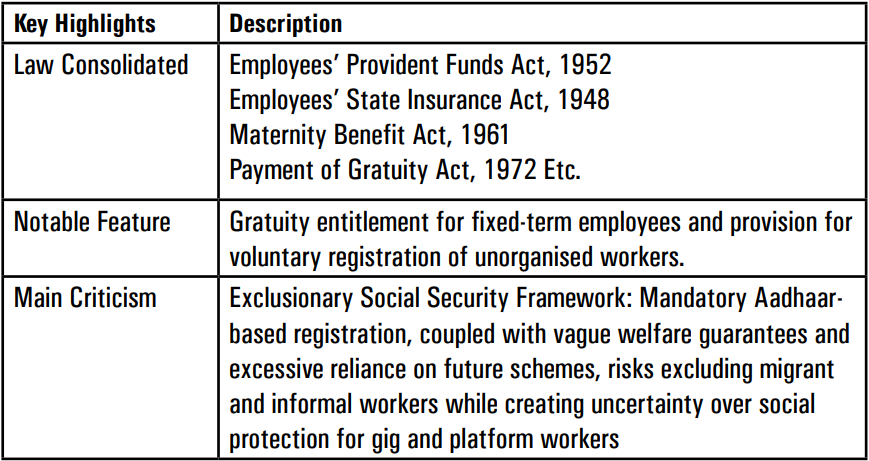
3. Code on Social Security, 2020
Expanding the Social Security Net
The Code on Social Security consolidates nine existing legislations, including laws relating to provident funds, employee insurance, maternity benefits, and welfare of unorganised workers, into a single framework. Its most significant contribution is the formal recognition of gig workers and platform workers, bringing previously excluded categories of labour within the ambit of social security for the first time. This expansion broadly aligns with ILO principles that advocate extending social protection to all workers, irrespective of the nature of employment.
4. Occupational Safety, Health and Working Conditions Code, 2020
Towards Inclusive Welfare Protection
The Code seeks to broaden access to social security benefits by providing for schemes relating to provident fund, gratuity, maternity benefits, health protection, employment injury compensation, old-age support, housing, and welfare measures for unorganised workers. The inclusion of maternity benefits and welfare provisions for gig and platform workers reflects an effort to adapt labour protection to the realities of a changing workforce and the growing digital economy.
Recognition Without Guaranteed Coverage
While the recognition of gig and platform workers is widely regarded as a progressive step, concerns remain regarding the actual delivery of benefits. Registration under the Code requires Aadhaar-based identification, which may create barriers for migrant workers, informal workers, and individuals lacking stable documentation. Further, many of the substantive welfare benefits are left to future schemes to be framed by the government, raising concerns that legal recognition may not necessarily translate into effective social security coverage.
Challenges of Implementation and Uniformity
The Code provides significant discretion to the Central Government in designing and administering social security schemes, while offering limited clarity on funding responsibilities and implementation mechanisms. Critics argue that the absence of uniform minimum standards across States could result in uneven access to benefits and inconsistent implementation. Questions have also been raised regarding the legal status of gig workers, who, despite being recognised under the Code, continue to remain outside the traditional employer-employee relationship, potentially limiting the extent of protection available to them.
Consolidating Workplace Safety Laws
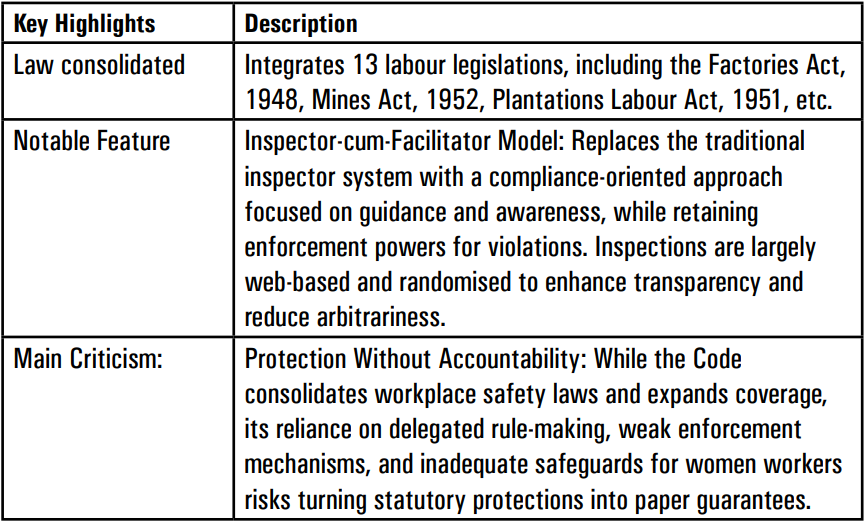
The OSH Code consolidates 13 labour legislations governing workplace safety, health, and working conditions, including laws relating to factories, mines, plantations, contract labour, building and construction workers, and inter-State migrant workers. By creating a unified framework, the Code seeks to simplify compliance and establish more uniform standards across sectors.
Expanding Safety and Welfare Protection
A key feature of the Code is the extension of occupational safety and health obligations to a wider range of establishments, including those employing ten or more workers and all hazardous establishments irrespective of workforce size. The Code mandates health and safety measures, periodic medical examinations for workers engaged in hazardous occupations, and welfare facilities for contract labourers.
Advancing Inclusion in the Workplace
The Code introduces several measures aimed at making workplaces more inclusive. It expands the definition of inter-State migrant workers to include self-employed migrants and provides benefits such as travel allowances, welfare portability, and access to grievance redressal mechanisms. The Code also permits women to work in all establishments, including night shifts, subject to their consent and the provision of adequate safety, transportation, and security measures by employers.
Unlike ILO standards that emphasise tripartite consultation among governments, employers, and workers, the Code offers limited institutional safeguards for meaningful worker involvement in wage-setting decisions.
Persistent Implementation Concerns
Despite its ambitious scope, concerns remain regarding the effective enforcement of workplace safety standards. Much of the operational framework has been left to subordinate legislation and future rulemaking, creating uncertainty regarding implementation. Critics argue that India’s longstanding challenges in enforcing occupational safety norms may persist unless monitoring and inspection mechanisms are significantly strengthened. Questions have also been raised regarding the adequacy of safeguards against workplace harassment and violence, particularly for women workers, as well as the gap between statutory protections and their actual realisation on the ground.
The Labour Codes promise simplification, flexibility, and wider coverage. Yet the real debate is not whether the laws are simpler, but whether workers are better protected than before. A closer look reveals three major concerns.
Flexibility for Employers, Uncertainty for Workers
Perhaps the biggest criticism of the Labour Codes is that they make it easier for employers to hire and fire workers while offering limited additional security in return. The Industrial Relations Code raises the threshold for prior government approval for layoffs, retrenchment, and closure from 100 to 300 workers. Supporters argue that this will encourage firms to expand and create jobs. Critics, however, fear that it weakens job security for workers in medium-sized establishments.
The restrictions on strikes and the additional procedural requirements imposed on trade unions have also raised concerns. At a time when unionisation in the private sector is already weak, limiting workers’ ability to collectively bargain may further shift the balance of power towards employers. The introduction of fixed-term employment reflects the same trend: while workers receive equal benefits during employment, the ease of non-renewal can make employment more insecure in practice.
The Labour Codes promise simplification, flexibility, and wider coverage. Yet the real debate is not whether the laws are simpler, but whether workers are better protected than before
Rights on Paper, Uncertainty in Practice
The Social Security Code’s recognition of gig and platform workers has been widely welcomed. However, recognition alone does not automatically translate into protection. Many welfare benefits are dependent on future schemes and executive decisions, leaving workers uncertain about what they are actually entitled to receive. Similarly, mandatory Aadhaar-based registration may create barriers for migrant and informal workers who often struggle with documentation.
The Occupational Safety, Health and Working Conditions Code faces a similar challenge. While it promises better safety standards, welfare measures, and broader coverage, many important details have been left to future rules. India’s experience suggests that labour rights often fail not because laws are absent, but because implementation is weak. Without adequate inspections, monitoring, and grievance mechanisms, legal protections may remain largely symbolic.
The Challenge of Implementation and Accountability
The success of the Labour Codes ultimately depends on how effectively they are implemented. Questions remain regarding the division of responsibilities between the Centre and States, funding arrangements, and the functioning of new dispute-resolution mechanisms. The shift from traditional labour inspectors to the Inspector-cum-Facilitator model places greater emphasis on self-compliance, raising concerns about oversight in sectors marked by informality and labour violations. Extending social security and workplace protections to millions of unorganised, gig, and migrant workers will also require substantial administrative capacity, digital infrastructure, and awareness-building.
Ultimately, the Labour Codes will be judged not by the promise of simplification but by their ability to improve workers’ lives. As India moves towards the vision of Viksit Bharat 2047, the real question is whether labour reforms will merely make business easier, or whether they will also make work more secure, dignified, and equitable for the millions who power the country’s growth.
NEXT »


