
Summary: Fact-Finding Report by Jan Hastakshep
Recent Repression of Workers’ Movements
Mohd Aasif *
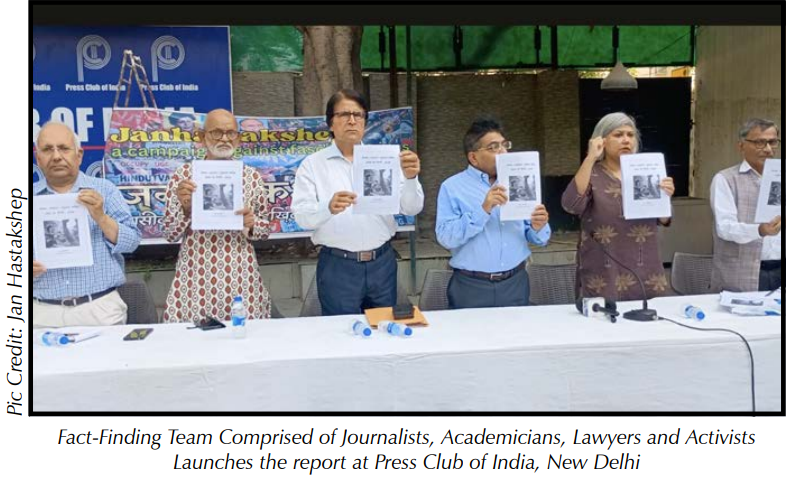
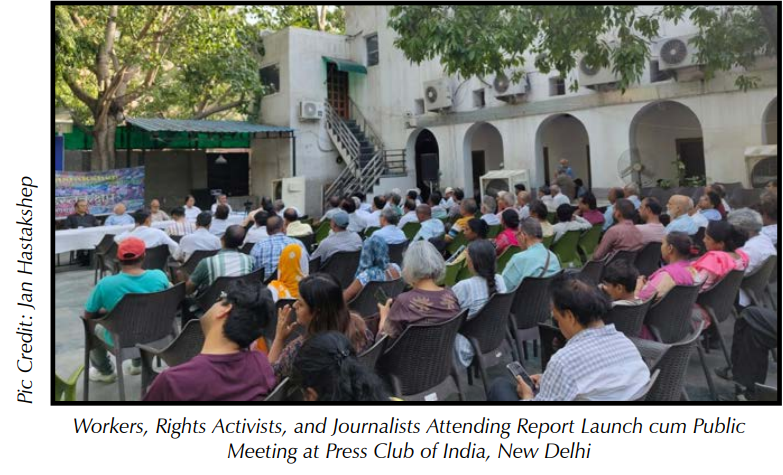
On 19th June 2026, Jan Hastakshep, a group of journalists, lawyers and trade unionists, organised a wellattended public meeting-cumpress conference at the Press Club of India, New Delhi. The occasion was the launch of its fact-finding report on the repression of the workers’ movements in Noida and Gurgaon-Manesar. The report was based on the findings of two separate investigation teams that visited the sites of workers’ SUMMARY: FACT-FINDING REPORT Recent Repression of Workers’ Movements Mohd Aasif * protests at Noida and Gurgaon Manesar factory area. The excerpts are given below:
The fact-finding report notes that Noida and Greater Noida house around 20,000 industrial units, employing around 1.7 million workers, over 75 percent of them contract workers. A large number of workers in Noida live in flood-prone areas of the Hindon River in slum-like conditions. Typically, the whole family lives in a single room with a dimension of 8 fee by 10 feet. Similarly, Gurgaon has approximately 20,000 small and large industrial units with employment patterns just like Noida, with over 70 percent accounting for contract workers out of a total of around one million workers.
The report states that over the past one and a half decades, the companies have been replacing permanent workers with contract workers, mostly hired through third-party agencies and contractors. A large number of workers in NCR are informal workers, and most of the companies maintain separate unofficial registers for such employees, depriving them of appointment letters or salary slips. In order to keep the employees informal, companies dismiss them for a few days and rehire them. Often, such workers do not receive essential benefits such as bonuses, Employee Provident Fund (EPF), Employee State Insurance (ESI), or leaves and therefore, for all practical purposes, they don’t exist on any government records.
Contract workers face another form of discrimination. They are not allowed to be members of any union in and around the industrial area. The report suggests that if a union enrols contract workers, the labour department revokes the recognition of the union, acting upon the complaint of company management. In the absence of collective bargaining, the contract workers are left at the mercy of the company management with the government agencies looking the other way.
Contract workers face another form of discrimination. They are not allowed to be members of any union in and around the industrial area. The report suggests that if a union enrols contract workers, the labour department revokes the recognition of the union, acting upon the complaint of company management.
The report notes that the Haryana government had not increased the minimum wages of workers and contract labourers for 10 years (despite the statutory requirement of doing so every five years). Workers were found to be receiving around Rs. 11,200 only as monthly wages, that too without the dearness allowance and after deducting the ESI, EPF and canteen expenses. The report says that the workers’ protest was triggered by their distressed conditions, low wages, soaring inflation and the recent fourfold increase in the prices of cooking gas. Most of the workers’ families in and around the factories in Noida, Gurgaon-Manesar, are forced to put their children to work before they turn 18 while discontinuing their education. In the recent strikes, the workers came out on the streets demanding a modest raise in wages and their mandatory rights.
State Violence on Workers
On 7th April 2026, several trade union leaders were arrested in order to prevent them from participating in the negotiation with the representatives of the district administration, labour department, and company management. Police allegedly threatened them “not to be seen in Manesar again”. Yet, the movement continued. The next day, Haryana government announced minimum wages of Rs. 15,200 for unskilled workers and Rs. 18000 for skilled workers. However, the management refused to post the notice on the company notice board for workers’ assurance.
This, says the report, created another wave of agitations, which prompted police action like an unprovoked lathi-charge, injuring 30 contract workers, including 10 women. Workers submitted their complaint to Assistant Labour Commissioner regarding police violence at the factory. During the night, police conducted raids in the villages and arrested 44 people, including women. The fact-finding committee reports that police raided villages in plain clothes and mistreated and arrested workers from their houses, showing no arrest documents. Serious charges were slapped on them, including those of attempts to murder, which have been denied by the workers. The arrested individuals include trade union activists, students, journalists, or those seen in the CCTV footage.
The report notes that the police action came with violations of due procedures. Arrested people were deprived of legal assistance and are struggling to obtain bail. This has also led to an atmosphere of fear, with a large number of them fleeing to their hometowns and those who have returned are not going back to their previous workplaces.
NEXT »


