
Is Viksit Bharat Anti-Labour?
India’s Growth Story Can Also be Pro Worker
Divya Chauhan *
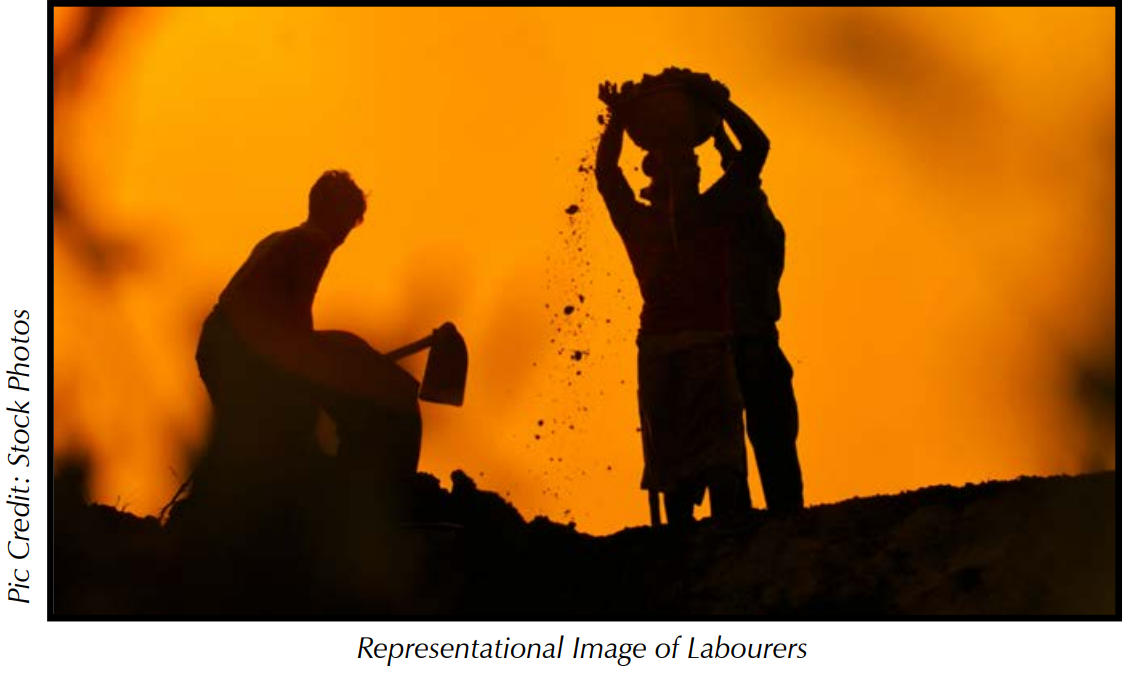
The country was taken aback by the recent remarks of the Chief Justice of India, which laid bare the realities confronting millions of workers.
While hearing a PIL involving domestic workers, Chief Justice Surya Kant remarked that trade unionism had been largely responsible for stalling industrial growth in the country. “How many industrial units in the country have been closed thanks to trade unions?” he asked before adding that traditional industries across India had been shut because of “jhanda unions”1.
The significance of the remarks lies less in the judge who made them than in how familiar they sounded. Trade unions are no longer widely discussed as democratic organisations through which workers negotiate unequal relationships with employers. They are not remembered as institutions that fought for the eighthour workday, workplace safety, maternity protections or minimum wages. Increasingly, they are viewed as obstacles to growth itself.
Seen in isolation, the Court’s comments might be dismissed as a stray judicial remark. Seen in the context of contemporary India, however, they reveal something larger: a development model that is becoming increasingly impatient with labour.
When Workers Become the Problem
Only weeks earlier, the Supreme Court’s remarks comparing unemployed youth to “cockroaches” and “parasites” generated controversy.2 The later clarification apart, the language itself was revealing. It reflected a political culture increasingly willing to view those left behind by economic transformation as burdens. Unemployment is increasingly seen as an individual failing rather than a structural problem, and the unemployed are dehumanised.
Over the last decade, India has witnessed a steady transformation in the way political elites, policymakers and large sections of the media discuss labour. What makes the present moment distinctive is not merely the weakening of labour’s bargaining power but the ideological confidence with which anti-labour positions are now articulated. The objective is no longer simply to restrict labour’s power. It is to redefine labour’s expectations.
Workers are encouraged to think of themselves as individual market actors rather than members of a collective class. Legally, they may retain the right to unionise. Materially, however, collective organisation increasingly occurs under conditions of intimidation, surveillance and hostility. Collective bargaining is framed as an economic obstruction. Labour rights are tolerated in theory but viewed with suspicion when workers attempt to exercise them in practice.
This shift is central to understanding the politics of Viksit Bharat. The question is not whether workers formally possess rights. It is whether the institutions that allow workers to exercise those rights are being steadily delegitimised.
This shift is central to understanding the politics of Viksit Bharat. The question is not whether workers formally possess rights. It is whether the institutions that allow workers to exercise those rights are being steadily delegitimised.
The Price of Viksit Bharat
The events in Noida earlier this year offer a useful place to begin. Thousands of workers took to the streets demanding something astonishingly modest: legal wages, regulated working hours, overtime pay and weekly leave. Not higher wages. Not extraordinary benefits. Just legal wages.3
Videos from Noida Phase II showed workers running through smoke while police in riot gear chased them through one of the country’s most celebrated industrial corridors. Vehicles were torched, women workers were beaten, and FIRs were filed against workers and “unknown persons”. Workers alleged years of stagnant wages amid spiralling inflation, withheld overtime, contractual exploitation and abusive working conditions in factories powering Noida’s manufacturing economy. Days later, the Uttar Pradesh government revised minimum wages retrospectively and initiated proceedings against more than 200 contractors accused of violating labour laws.4 Workers had to disrupt industrial production before the law became visible. Rights that existed on paper required confrontation to become meaningful in practice.
The pattern was hardly confined to Noida. Early last year, in Manesar, the Haryana police cracked down on protesting Maruti Suzuki workers who had been conducting a prolonged dharna over labour conditions. Protest sites were dismantled, and workers were forcibly dispersed after Section 144 orders were reportedly imposed in the area. Once again, the issue ceased to be the grievances that produced the protest and became the protest itself.5
The government’s labour codes sit at the centre of this transformation. Presented as modernisation, the reforms alter the balance between labour and capital. The Industrial Relations Code, for instance, extends restrictions on strikes through notice requirements, cooling-off periods and procedural barriers that, unions argue, make effective collective action substantially more difficult.6
The government has repeatedly defended the labour codes as a long-overdue rationalisation of an unwieldy regulatory framework, arguing that flexibility will encourage investment and job creation. However, this narrative obscures a fundamental historical reality. Labour law did not emerge as a benevolent gift from the State, nor was it designed to burden employers with unnecessary regulation. It emerged because employers and workers enter the labour market with vastly unequal power. One side controls capital, hiring decisions and workplace conditions; the other depends upon wages to survive. Labour protections, collective bargaining rights and trade union freedoms were created to moderate this imbalance.
The official story of Viksit Bharat is one of rising infrastructure, global supply chains, industrial corridors, semiconductor ambitions, AI data centres and ease of doing business. The unofficial story can be seen in factories, construction sites, warehouses and delivery routes across the country. It is visible in the growing dependence on contract labour and the expansion of precarious work.
In West Bengal, tea plantation workers, represented by the Paschim Banga Cha Majoor Samity, recently petitioned the International Labour Organisation under Article 24, alleging systemic violations of labour rights despite India’s commitments under ratified international conventions. Their petition describes starvation deaths, severe malnutrition, non-payment of wages, the denial of minimum wages, and persistent discrimination against women and Adivasi workers.7 The fact that such allegations emerge from one of India’s oldest organised industries illustrates how legal guarantees often fail to translate into material protections.
Labour law did not emerge as a benevolent gift from the State, nor was it designed to burden employers with unnecessary regulation. It emerged because employers and workers enter the labour market with vastly unequal power
A similar pattern emerged at Indian Oil Corporation’s Panipat refinery expansion project. In early 2026, more than 20,000 workers halted work and launched a strike over basic working conditions. Contract labourers reported that adequate drinking water, sanitation facilities, and other essential amenities received serious attention only after production was disrupted.8 Although work resumed after several days and some concessions were granted, many workers argued that their core demands remained only partially addressed.
The situation is often far more severe in sectors that operate largely beyond public scrutiny. Investigations into the brick kilns of Telangana and Andhra Pradesh have documented the conditions faced by nearly half a million migrant workers from western Odisha. Workers frequently labour under arrangements resembling debt bondage, while employers openly disregard labour regulations. Women are forced to bathe and relieve themselves in the open, exposing them to serious risks, including sexual violence. Children are routinely pulled out of school and often made to work without pay. Exposure to fly ash and coal dust creates serious health hazards, while regulatory oversight remains strikingly absent. Officials empowered to inspect work sites or prosecute violations rarely visit kilns without prior notice to owners, contributing to the normalisation of exploitation.9
Even workers employed within State-supported welfare infrastructure face similar insecurity. According to a 2024 IndiaSpend report, Delhi’s Jan Suvidha Complexes, established under the Swachh Bharat Mission to provide sanitation facilities to residents of informal settlements, rely on caretakers and sanitation workers who often experience chronic wage delays and low pay. Workers responsible for maintaining facilities used by hundreds of thousands of people report working well beyond standard hours while struggling to receive wages on time.10
The contradiction is striking: public infrastructure intended to improve dignity for some citizens is sustained by workers whose own economic and social security remains deeply precarious.
Evidence from the recently released Crushed 2025 report further highlights the gap between legal reform and workplace reality. Drawing on the experiences of more than 7,000 injured workers in India’s automotive supply chains, the report found widespread violations of protections ostensibly guaranteed under the new labour codes. Appointment letters remain absent for 97 per cent of workers, excessive working hours persist, minimum wage violations are common, and hazardous workplaces continue to produce preventable injuries. Fifty per cent workers reported that safety inspections often occur only after accidents have already taken place.
Taken together, these cases illustrate a pattern that extends beyond individual employers or isolated violations. Across sectors, workers are increasingly expected to absorb the costs of India’s growth while possessing fewer effective mechanisms through which to negotiate its terms.
The rise of platform capitalism intensifies this labour vulnerability. Gig workers exist in a legal grey zone where companies exert extensive control over wages, incentives, surveillance and performance while denying employer responsibility by classifying workers as “partners” or “independent contractors”. If the objective is genuinely inclusive development, labour policy must begin not from the assumptions embedded in formal employment contracts but from the realities of how most Indians actually work. A majority of workers remain employed in informal, precarious or semi-formal arrangements where employer accountability is often weak and social protections are difficult to access. For such workers, meaningful protection requires universal access to healthcare, maternity benefits, pensions and social security that are not contingent upon a stable employer-employee relationship.
International Experiences Suggest Solutions
Several middle-income countries have demonstrated that alternative approaches are possible. Countries like Thailand11 have expanded social protection by treating welfare as a right attached to individuals rather than a privilege attached to formal employment. By contrast, many advanced industrial economies, including the United States, the United Kingdom and Germany, operate through clearly defined employeremployee frameworks reinforced by State-funded safety nets, automated payroll reporting systems and active oversight institutions.
Regulatory bodies and worker-representation structures help ensure that the costs of labour protection are distributed across a broader social framework rather than being left solely to individual workers or employers.12 The lesson to be learnt is that labour protection can be embedded within successful development strategies rather than treated as an obstacle to them.
The argument for stronger labour protections is often dismissed as a moral appeal that must be balanced against economic efficiency. Yet international evidence suggests that the relationship may run in the opposite direction. India’s ambition to become a global manufacturing hub increasingly depends upon improving the quality and productivity of work itself. According to ILO labour productivity13 estimates, India continues to lag behind many comparable economies in output per hour worked, while assessments of labour rights point to persistent weaknesses in workplace protections, safety standards and enforcement.
Experiences from comparable countries such as Chile and Costa Rica are instructive. As workplace injuries declined through stronger safety measures and more effective enforcement, labour productivity rose steadily, particularly in manufacturing and construction sectors similar to those that India hopes to expand. Safer workplaces reduce absenteeism, improve workforce retention, enhance skills accumulation and increase efficiency over time.14
Gig workers exist in a legal grey zone where companies exert extensive control over wages, incentives, surveillance and performance while denying employer responsibility by classifying workers as “partners” or “independent contractors”
No nation develops in the abstract; every development model rests on a labour model. The real question facing India is whether workers will be treated merely as instruments of growth or as citizens whose rights and welfare are fundamental to development itself. The debate, therefore, is not growth versus labour, but what kind of growth a democratic society should aspire to build. The future of Viksit Bharat will ultimately be judged not by the highways it builds or the investments it attracts, but by whether the workers who make that development possible share its dignity, security and rewards.
The real question facing India is whether workers will be treated merely as instruments of growth or as citizens whose rights and welfare are fundamental to development itself
References
- The Print (29 January, 2026) https://bit.ly/4oGyQhD
- The Wire (16 May 2026) https://bit.ly/4uLp7Ip
- The Times of India (13 April 2026) https://bit.ly/4g4ymzL
- Ibid.
- AICCTU, Debunking the Press Release on Labour Codes. https://bit.ly/4494TgV
- https://www.downtoearth.org.in/governance/west-bengal-tea-workers-invoke-ilo-article-24-allege-systemic-labour-rightsviolations
- https://www.thehindu.com/news/cities/Delhi/fight-for-rights-continues-say-workers-back-at-iocls-panipat-refinery-after-5-daystrike/article70741128.ece
- https://article-14.com/post/no-housing-no-toilets-no-medical-care-no-schooling-bonded-labourers-face-assault-sexualviolence-denial-of-rights-64dd91d170607
- IndiaSpend (17 February 2024) https://bit.ly/4vvinzA
- UN Thailand, Thailand Social Protection Diagnostic Review (2022) https://bit.ly/4en5y47
- Arnav Kaushik, Comparative Analysis of Labour Laws in India, UK and USA, Indian Journal of Legal Review (IJLR), 5 (1) Of 2025. https://ijlr.iledu.in/wp-content/uploads/2025/02/V5I175.pdf&embedded=true
- ILOSTAT, https://ilostat.ilo.org/topics/labour-productivity/
- Safe in India (SII), Crushed 2025.
NEXT »


