
Gig and Platform Workers
Do the New Labour Codes Cover Their Issues?
Dr. Sarthak Bhatia
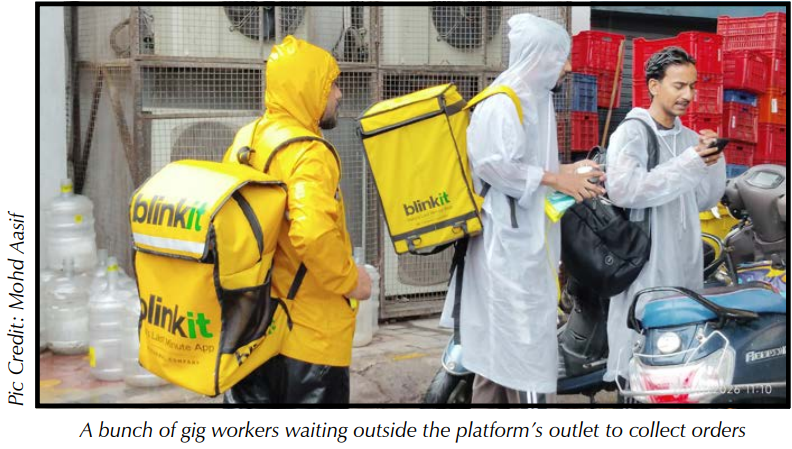
Platform-based work has become ubiquitous in the country, with “the potential to become a major form of work in the future1 . Platforms like Uber, Ola, Zomato, Swiggy, Rapido, Urban Company, Porter, etc. have become household brands providing myriad services to the affluent and aspirational sections of the population. Their rapid expansion into even smaller cities and towns is routinely invoked as a marker of the success of euphoric campaigns like Digital India. The backbone of these services are the gig and platform workers, most visibly those working for ride-hailing, food delivery and home-based services platforms.
These workers increasingly report being underpaid, overworked, and disenchanted with the digital economy. For the first time, such workers have been covered under India’s new labour codes, whose stated objective is to secure labour reforms and the dignity of work. In this article, we try to understand their issues and analyse the Code on Social Security and some recently promulgated state legislations that aim to secure welfare for the gig and platform workers.
Platform Economics
The point of entry for the typical platforms of the late 2000s—Uber and Airbnb— was the conception of sharing economy, which asserted that technology companies could usher in a novel basis for the economy sharing idle resources and personnel between participants. The platforms were meant to mediate between different sides of the market. These companies positioned themselves as ‘aggregators’, ‘intermediaries’, or ‘digital marketplaces’, building bridges between the demand and supply in real time.
It was claimed that network effects - the mechanism by which the value of a product or service increases as more people use it - would enable digital marketplaces to substitute traditional markets while securing consumer interest through ratings and feedback mechanisms2 . The platforms thus posited themselves as neutral participants facilitating exchange at minimal transaction costs using algorithmic models and realtime data.
The platform’s relationship with workers was based on terms of service agreements, rather than employment contracts; workers were classified as independent contractors working at their personal expense (costs related to vehicle ownership, fuel, maintenance, insurance, smartphone, data, etc). The relationship was therefore posited by the former as lying outside the worker-employer paradigm, absolving the platforms of the legal responsibility to pay for any social security or even minimum wages. The future of work, mediated by digital technologies without the constraints of fixed-term contracts, was hailed as flexibility, autonomy and independence for the workers.
In practice, however, platforms exert far greater control over the workers. Most platforms use rating systems to monitor worker behaviour, automate decision-making to organise production processes, and leverage data to refine their operations or develop new services. Platforms frequently change terms of services to modulate workers’ behaviour. This includes incentive-based payments, surge pricing, and worker classification based on ‘performance’ , amongst other mechanisms. Absent a novel regulatory framework capable of stabilising their contractual relationship with the workers, platforms have circumvented existing legislation and even thwarted new legislation through direct lobbying (and appeals to consumer interests). These companies can work in a regulatory grey zone by obfuscating both the degree of control over workers and the workers’ dependence on the platform, and by positioning themselves as merely technology companies rather than employers.
Issues of Platform Workers
The most consistent pattern observed with platform work is the precarity of work, the unpredictability of income, and the opacity in conditions of engagement. Precarity is intensified by a structured lack of clarity on how exactly work is allocated or how the number of workers is regulated by the platforms. Even customer ratings do not appear to be central since platforms use internal systems for allocating work. Kept in the dark about specific requirements governing work, workers are forced to remain ‘logged in’ and be available for work for ever longer durations. The workday has effectively lengthened to twelve or fourteen (or even more) hours that are needed to secure a decent wage after expenses are deducted3 . The absence of regulations related to earnings and to minimum rest periods is the structural condition to overstretch and overwork, leading to stress and safety-related issues.
Extensive surveillance to discipline workers and a tendency to ‘experiment’ with different conditions of work effectively sustain the platform companies’ own flexibility to operate. Workers frequently report a lack of clarity over fines and deductions in their earnings. Transgressions that can be punished range from not wearing the designated uniform or not carrying company bags (for which the platforms devise novel ways of surveillance) to cancelling gigs or even organising workers. Platforms are frequently accused of blocking worker IDs, leading to the loss of income, simply with a push notification.
The lack of any meaningful social security net has led to increasing misery for workers. Lacking social protection benefits and any income support when not working in case of illness or accidents, the workers bear major risks with regard to the physically demanding nature of the work. Platform work is extensively shaped by the gamification of the workers’ mobile applications, with some platforms even offering fragmented, conditional benefits like an expanded insurance cover and more gigs, tactics that effectively reinforce workers’ selfexploitation. On the other hand, platforms pointedly shift the onus onto the customers by encouraging them to pay workers tips for completing the gigs.
The lack of any meaningful social security net has led to increasing misery for workers. Lacking social protection benefits and any income support when not working in case of illness or accidents, the workers bear major risks with regard to the physically demanding nature of the work
Code on Social Security 2020
The Code on Social Security 2020 (CSS) seeks to consolidate and amend existing laws, and introduce new schemes related to the social security and welfare of employees, unorganised workers, gig and platform workers4 . The code’s definitions of the latter are notably broad and vague: Gig and platform workers are defined as having work arrangements that lie “outside of the traditional employer-employee relationship” with the addition that the platform workers “solve specific problems or provide specific services” for other organisations and individuals “using an online platform”. An aggregator is a “digital intermediary or a marketplace” connecting buyers and sellers. The code brings all categories of aggregators under the same framework, while leaving open the option of legislating for workers belonging to sector-specific aggregators to a future date.
The code frames two broad operational mechanisms regarding gig and platform workers: registration of workers, and the constitution of social security organisations to notify welfare schemes5 . Workers are to be mapped to a unique ID which shall make them eligible for benefits under any schemes launched by the state or central government. The code envisages the constitution of a National Social Security Board that would notify central govt welfare schemes (related to life and disability cover, accident insurance, health and maternity benefits, old age protection, creche, skill upgradation, and other benefits).
The schemes could be partially or fully funded by the state and central govt, or by the contributions from the aggregators and the workers or through CSR funds. The contribution of the aggregators is capped at 5% of the total payouts made to the workers6 . Other than representatives of various state and centre govt, including the director of ESIC and PF commissioner, the board will also have five members, each representing the gig & platform workers and the aggregators nominated by the central government.
It is unclear if the code considers the gig workers and platform workers as part of the unorganised sector, although Chapter 9 of the code groups the three kinds of workers together. Unorganised sector workers had expanded protections under the Unorganised Workers’ Social Welfare Security Act 2008 (now subsumed by the CSS). A 2021 petition filed by Indian Federation of App-based Transport workers and others in the Supreme Court argues that gig and platform workers are essentially employed by the aggregators/ platforms and should be considered as ‘wage workers’ or ‘unorganised workers’ within the meaning of UW act, 2008; and hence eligible for the benefits therein.
State Based Legislation
The CSS also provides for the constitution of State Unorganised Workers’ Social Security Boards that enables state governments to frame specific schemes related to different sections of unorganised sector workers, while also providing a separate tripartite consultative mechanism. At least five states have either promulgated or drafted legislation related to gig and platform workers7 each providing specific mechanisms to ensure the security and welfare of gig and platform workers.
Registration of Workers and of Aggregators: State legislation mandates registering the aggregators as well as making them responsible for ensuring that workers are registered, and that an updated worker database is sent to the respective boards A gig worker delivering food on a rainy day. for monitoring purposes.
Income Security: The CSS considers income security within the ambit of social security, but it is in the state legislation that we find how its specific contours are defined for the gig and platform workers. In all but one state, income security is narrowly framed as pertaining to only the responsibility of the aggregators/platforms to inform workers about the reasons for any deductions in their payouts, and to make time-bound payments. Jharkhand makes a significant departure by mandating that aggregators pay workers at least a minimum wage calculated on the basis of time spent and distance travelled per task, requiring the welfare board to ensure that aggregators contribute to the welfare fund.
Aggregators must also take measures to prevent any discrimination on the grounds of religion, race, caste, gender, place of birth, or disability by these systems.
Termination From Work: Against the widespread practice of blocking IDs on the smallest pretexts and without stated reasons, the state legislations prohibit aggregators from terminating workers without providing valid reasons grounded on the principles of natural justice, providing prior notice. Some states mandate the aggregators to have an exhaustive list of grounds for termination in the worker contract itself.
Welfare Fund: The state boards are to establish social security and welfare funds from which benefits and entitlements will be disbursed to the workers. These funds will draw contributions from aggregators, workers, the state & central govt, corporate social responsibility funds, and other sources. Crucially, the state legislations seek to raise a welfare fee/cess from aggregators, based on the category/type of aggregators, as a percentage of the total payouts made to the workers8 . The state government, through the welfare board, shall be responsible for monitoring, verifying and collecting the contributions made by the aggregators, and for obtaining relevant information on each transaction. Although state legislation includes provisions to prevent overlap with contributions sought under the CSS, several platforms recently filed a petition in the Karnataka High Court to challenge the constitutionality of the state’s Platform Workers Act9 . The aggregator contribution might not be adequate to provide meaningful social security, especially as compared to the contributions made by employers in the “traditional” sectors10.
Grievance Redressal: Aggregators are mandated to provide a human point of contact for worker grievance redressal, an important provision for platform-based workers who are often forced to navigate automated systems11. Aggregators are also required to constitute Internal Dispute Redressal Committees and appoint Grievance Redressal Officers. Where necessary, workers may escalate unresolved issues to the welfare board and, thereafter, to an appellate body.
Automated Monitoring and Decision-Making Systems: To ensure transparency, aggregators are mandated to publish the procedures by which workers can obtain information about automated systems including algorithms governing work allocation and fare determination for a gig, and the effect of other parameters like the customer feedback or other ratings system. Aggregators must also take measures to prevent any discrimination on the grounds of religion, race, caste, gender, place of birth, or disability by these systems. The Bihar act even allows workers the ‘right to request a review of algorithmic and platform decisions affecting their livelihoods’ and includes provisions for human oversight of automated decisions. The aggregators are likely to contest these measures, framing algorithmic disclosures as an infringement of their proprietary technological systems. The EU platform work directive tackles issues of algorithmic accountability more substantively and may provide a useful comparative benchmark for a rights-based regulatory framework12.
Occupational Safety and Health: None of the laws explicitly deal with concrete measures to address occupational safety and health-related issues of the workers, confining the responsibility of the platforms only to provide “a safe working environment”. This lacuna is especially central for home-based workers who face specific risks of safety and dignity in private workplaces.
Conclusion
The CSS and state-level legislation mark an important point of entry for regulation of working conditions in the platform economy. Although detailed analysis of the legislation might be possible once rules are framed and the welfare boards start functioning13, important issues related to worker misclassification, lack of Occupational Health, Safety and Working Conditions (OSH) provisions, limited financial liability for aggregators, and the propensity towards welfarism remain significant impediments.
Global experience of platform regulation underlines that rights groups and workers’ unions will need to organise effectively to secure fair wages and meaningful social security, wanting classification as employees rather than independent contractors. Nonetheless, within the limits set by the categorisation, the state laws bring workers some protection against arbitrary platform power. Jharkhand and Karnataka are notable for trying to frame a rights-based approach rather than one premised on welfare schemes, with the former explicitly listing workers’ rights in the legislation.
References
- NITI Aayog (2022). India’s Booming Gig and Platform Economy
- Srnicek, N. (2017). Platform capitalism. John Wiley & Sons.
- PAIGAM and University of Pennsylvania (2024). Prisoners on wheels? Report on Working and Living Conditions of App-based workers in India.
- The Code on Social Security, 2020 (Act No. 36 of 2020) was partially brought into force in November 2025.
- The code also lays down the requirement to create helpline and facilitation centres for dissemination of workers in Section 112.
- The contribution is limited to 1-2% of the annual turnover of the aggregators, with aggregators having more than one business to be treated as separate businesses. The central govt also may exempt an aggregator or a class of aggregators from making any contributions.
- These are: Rajasthan platform based gig workers (registration and welfare) act, 2023; Karnataka platform based gig workers (social security and welfare) act, 2025; Jharkhand platform based gig workers (registration and welfare) act, 2025; Bihar platform based gig workers (registration, social security and welfare) act, 2025; Telangana platform based gig workers (registration, social security and welfare) act, 2026
- Jharkhand 2025 calculates the cess on the percentage of aggregator turnover rather than payouts.
- BL Bangalore Bureau (2026, June 30). Unions slam platforms after they move high court against Karnataka gig workers act. The Hindu Business line. https://bit.ly/44SBHuJ
- Centre for labour studies (2025). Comments and recommendation on the Draft Karnataka platform-based gig workers (social security and welfare) rules, 2025. National Law School of India University. https://bit.ly/4viV6Qo
- All India Central Council of Trade Unions (2025). The Karnataka platform based gig workers (social security and welfare) act, 2025: Precarity unaddressed!. https://bit.ly/4vTzZ8e
- European Parliament & Council of the European Union. (2024). Directive (EU) 2024/2831 of the European Parliament and of the Council of 23 October 2024 on improving working conditions in platform work.
- Till date, only the Karnataka Welfare board has been constituted.
NEXT »


