
Summary: Safe In India Report 2026
Exposing Lack of Occupational Safety & Health
Divya Singh Chauhan *
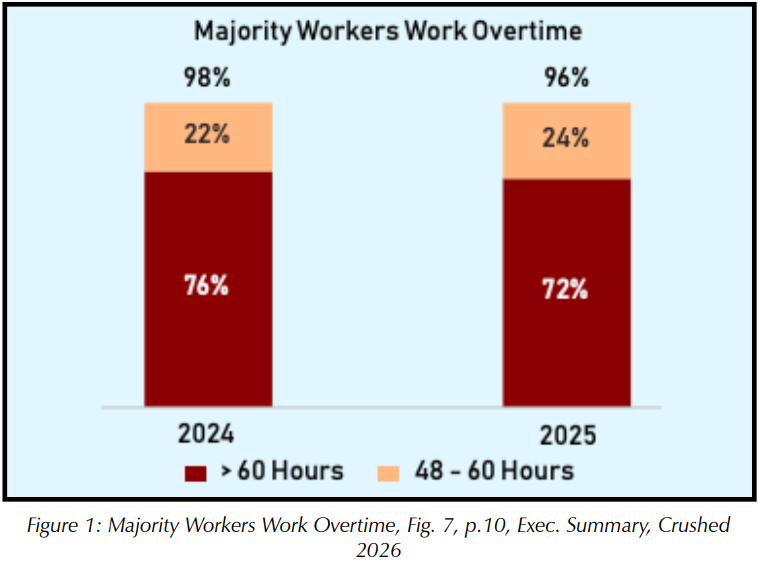
Safe in India’s CRUSHED 2026 report examines occupational safety and health (OSH), labour standards and worker protection across India’s automotive supply chains, drawing on the experiences of more than 11,000+ injured workers assisted since 2016. In addition to documenting injury trends and workplace conditions, the report presents a comparative assessment of OSH standards across Haryana, Karnataka, Maharashtra and Tamil Nadu, and reviews the implementation of key worker protection provisions under the Occupational Safety, Health and Working Conditions (Central) Rules, 2025.
Drawing on workers’ experiences, the report argues that several workers protections given under the Occupational Safety, Health and Working Conditions (Central) Rules, 2025, remain inadequately implemented. Despite the statutory weekly limit of 48 working hours, 72 percent of injured workers reported working more than 60 hours a week, while a further 24 percent worked between 48 and 60 hours.
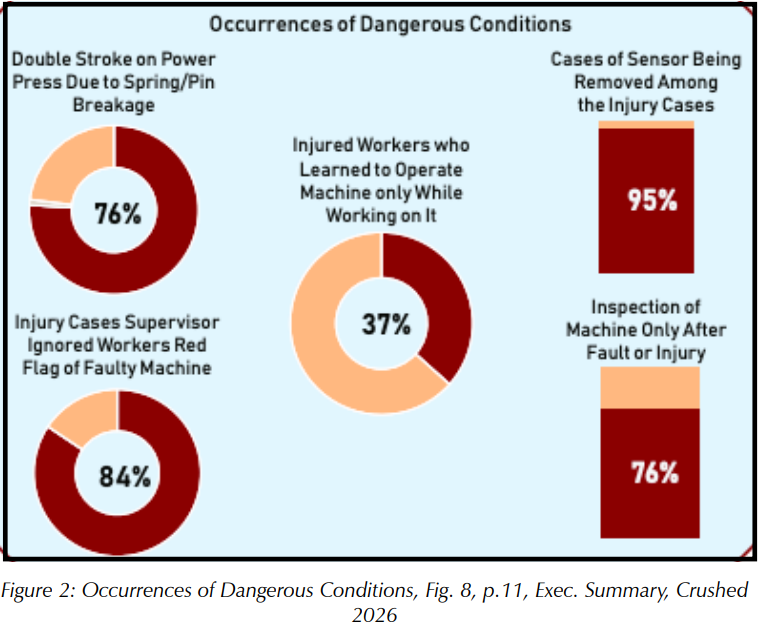
The report finds that workplaces remain dangerously hazardous despite legal requirements concerning safety. Use of unsafe machinery emerged as a major concern. Among injury cases examined, 76 percent involved double strokes on power press machines due to spring/pin breakage, 84 percent involved supervisors ignoring workers’ warnings about faulty machinery, 95 percent reported that machine inspections were carried out only after faults or injuries had occurred, 76 percent involved the removal of machine sensors, and 37 percent of injured workers reported learning to operate machines only while working on them.
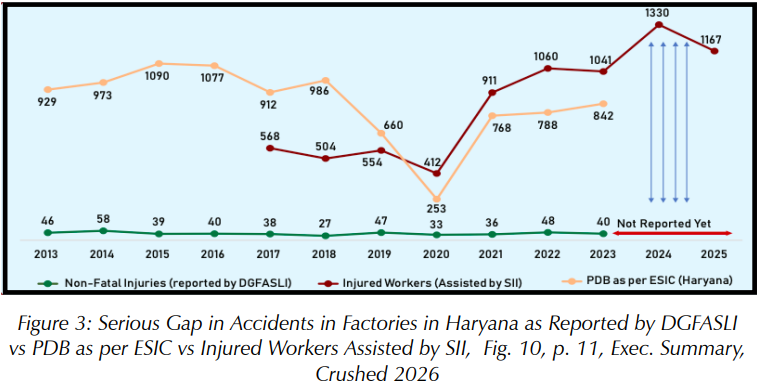
The report further finds that substantial under-reporting of industrial accidents continues despite statutory reporting requirements. In Haryana, only 40 non-fatal industrial injuries were reported to DGFASLI for 2023, while Safe in India assisted more than 1,500 workers injured during the same period through its Worker Assistance Centres.
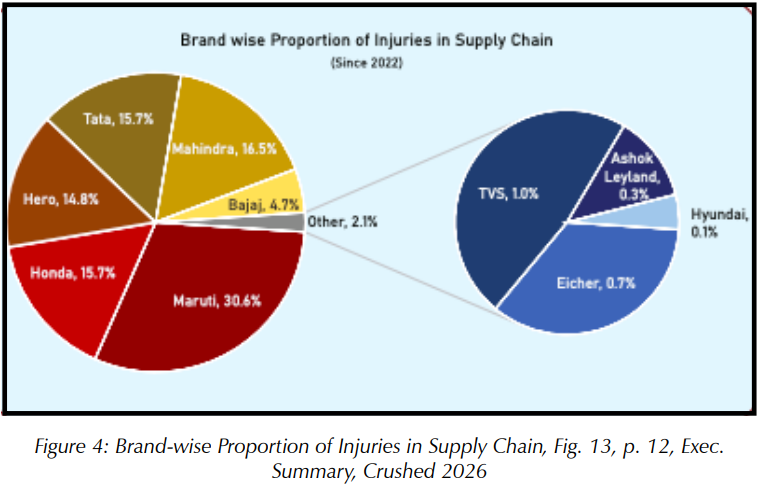
The findings indicate that workplace injuries are spread across the supply chains of multiple leading automobile brands. Since 2022, 98 percent of injured workers assisted by Safe in India came from the supply chains of Maruti Suzuki, Mahindra, Honda, Tata Motors, Hero and Bajaj. Maruti Suzuki accounted for 30.6 percent of injuries, followed by Mahindra (16.5 percent), Honda and Tata Motors (15.7 percent each), Hero (14.8 percent) and Bajaj (4.7 percent).
CRUSHED 2026 points to continuing gaps between the protections provided under the Occupational Safety, Health and Working Conditions (Central) Rules, 2025 and workplace realities. It documents persistent shortcomings in occupational safety, working hours, accident reporting, worker documentation and social security, and recommends stronger implementation of the Rules through improved enforcement, transparency and collaboration among government, industry, workers’ organisations and civil society. The report argues that improving working conditions is not only a critical human issue but also a business imperative, and that without these improvements, India will struggle to strengthen its manufacturing professionalism and labour productivity.
Visit https://www.safeinindia.org to download full report
NEXT »


