
Online Exposure and Its Drawbacks
Online Exposure and Its Drawbacks
Digital Access Increases Risks of Digital Fraud
Your phone rings, a cheerful voice announces that a parcel is waiting for you. You do not remember ordering one. You conclude that it maybe someone in your house – them and
their online shopping habits.
An exasperated sigh later, you ask the caller to carry on, slightly annoyed at the one at home not letting you know about their parcels.
The cheerful voice continues. Your parcel was caught at customs. At times it only needs a small payment to be cleared, other times it has illegal items that are going to get you prosecuted. The fraudster’s playbook is already in motion before you know it. Your name, your address, are recited back to you. Fear reaches your throat and opens it for your recital. Your family tree, your bank account, your workplace, all flow naturally to the “officer” who you have been transferred to now.
Table 1: High-return investment and fake delivery scams are among the most frequently reported fraud attempts
| Received a call/text message for | Many times | Sometimes | Rarely | Never | |
|---|---|---|---|---|---|
 | Investment opportunity, guaranteeing a high return | 10 | 21 | 20 | 45 |
 | Delivery of a product you never ordered | 8 | 25 | 20 | 44 |
 | Bank official asking for personal or account details | 7 | 20 | 21 | 49 |
 | The phone number has been linked to illegal activities | 6 | 17 | 16 | 56 |
 | An unknown number claiming to be your friend/relative who is in urgent need of money | 6 | 17 | 19 | 54 |
 | Call from police or someone in authority claiming that your friend / relative is in danger or has committed some crime | 5 | 15 | 18 | 59 |
Note: All figures are in percentages. Rest did not respond. Question asked: “How often do you receive a call/text message – Delivery of a product you never ordered/ Phone number has been linked to illegal activities/ Bank official asking for personal or account details/ Unknown number claiming to be your friend/relative who is in urgent need for money/ Police or an authority claiming a friend or relative is in danger or committed a crime – many times, sometimes, rarely, or never?”
If this sounds familiar, you are in large company. In the Status of Policing in India Report 2026, we surveyed 8,306 people across 16 states and found that the fraudster’s call is hardly a rare event. It is a common hazard of owning a phone.
This article delves into what we asked and learned in chapters 3 and 4 of the report. How often do these attempts reach people? What do they fear most? Do they feel targeted because of who they are? And who, in the end, actually falls victim?
Exposure to Cybercrime
Fraudsters are inventive. Their methods keep evolving and the novelty of their schemes casts a wide net in which victims are caught. Before the public realises such a net has been cast, it is reeled in and another takes its place. So, we asked respondents how often they come across such fraud attempts. One in three respondents had received fake calls about delivery of products they never ordered (33 per cent – combining “many times” and “sometimes”). A similar proportion encountered high-return investment scams (31 per cent – combining “many times” and “sometimes”). More than one in four (27 per cent) had received calls from individuals impersonating bank officials and asking for personal or account details. The frequency of exposure to other methods are given in Table 1.
When we look at exposure to cybercrime by class, the middle and high-income groups report more frequent scam calls/texts. For instance, about two in five (37 per cent) of those belonging to the middle class and over one in three (35 per cent) of those from the rich backgrounds frequently received fake delivery scam calls, compared to 29 per cent among the most economically disadvantaged. The pattern was similar across all types of fraud attempts.
Why might this be? There are two possible explanations. First, higher income groups may engage more actively in online transactions, investments, and e-commerce, while economically disadvantaged groups may interact differently with digital platforms, thereby making the former more vulnerable to cybercrime. Secondly, cyber fraud often involves profiling victims through publicly available information, bank and personal details, thus rendering those with greater financial means more vulnerable.
So, does deeper integration into the digital world increase one’s exposure to fraudulent attempts? To answer this, questions on the respondent’s usage of social media, online banking apps, and UPI were put together against the frequency of them receiving fraudulent calls/text. The answer was a resounding yes. Those who had the least internet activity were three times less likely than those with high online exposure to have a high likelihood of receiving fraudulent calls/text (Figure 1). Over half (54 per cent) of those who were not active on the internet reported receiving no fraud calls/texts, compared to over a fifth (22 per cent) of those with high internet activity. Figure 1 also shows a steady climb: as online activity increased, so did the exposure to fraudulent calls/texts.
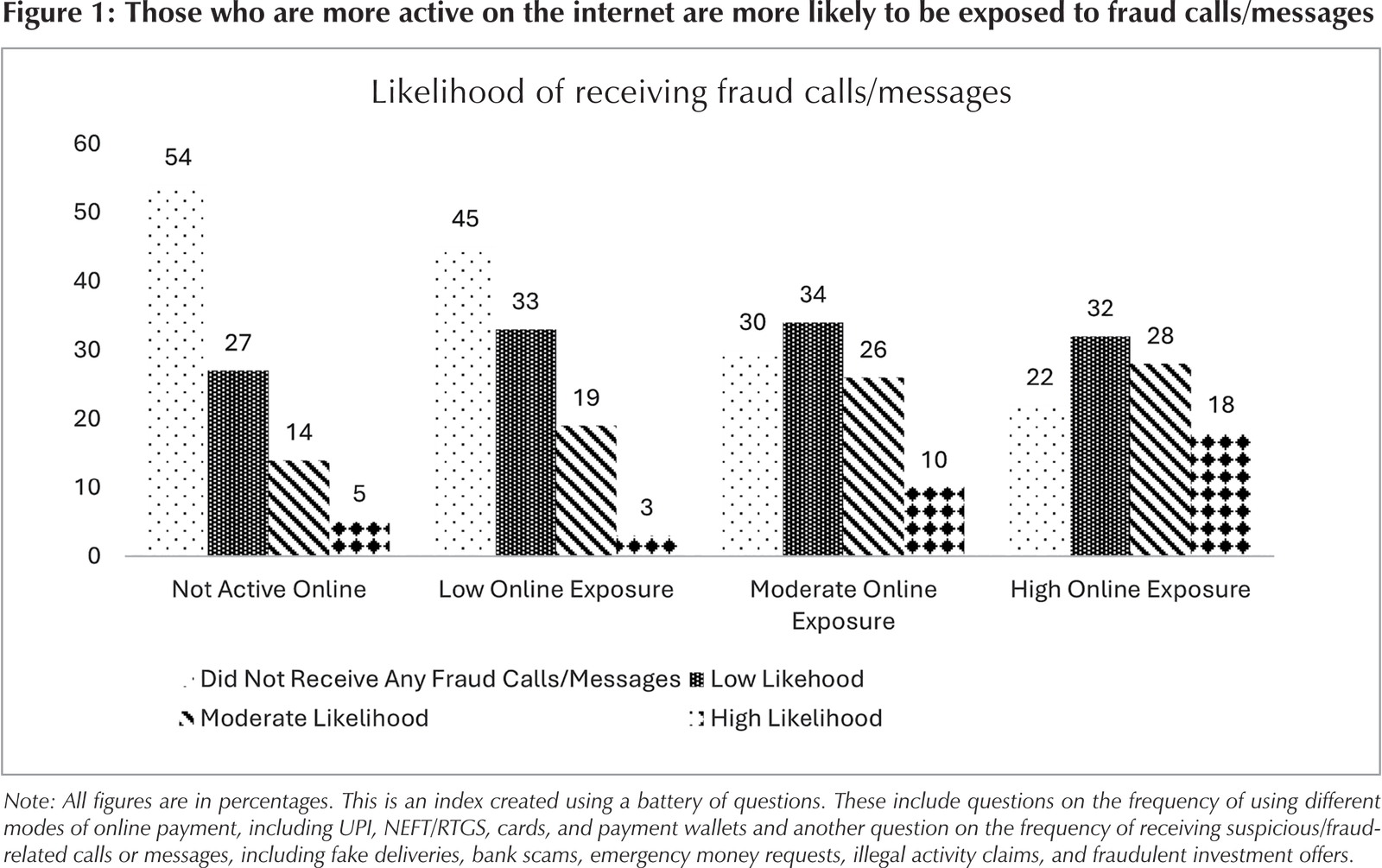
The same was observed for those who frequently use online payment services. About half (49 per cent) of those who do not use any online payment services reported never receiving any fraudulent calls/texts compared to only 14 per cent of those who use online payment services frequently. A quarter of those who frequently use online payment services reported a high likelihood of exposure to cybercrime attempts compared to only 6 per cent of those do not use online payment services. The incremental pattern was also the same, as usage of online payment services increased so did their exposure to fraudulent calls/texts.
Fear of Cybercrime
Fear of cybercrime was high across the board among respondents. People were most afraid of losing money through online fraud or scams, with over half (55 per cent) reporting high fear of being victimised. However, almost similar proportions were reported across other categories of cybercrime. Forty-seven per cent highly feared someone impersonating them online, one in two (51 per cent) highly feared identity theft (someone stealing and misusing personal IDs such as Aadhaar card), 49 per cent highly feared their devices being hacked, and the same proportion highly feared being recorded without their consent.
Women exhibited higher fear than men over all types of cybercrimes. They were also significantly more likely than men to feel vulnerable to online gender-based cybercrimes. Almost three in ten (29 per cent) women reported that they are very likely to be targeted online because of their gender, compared to two in ten (19 per cent) men.
When asked about their vulnerability online owing to their caste, Scheduled Tribes reported being most vulnerable. Amongst internet users in general, those who have high internet activity were the most likely to have a high fear of cybercrimes. Nearly one in five (18 per cent) respondents felt that they were very likely to be targeted online due to their sexual orientation.
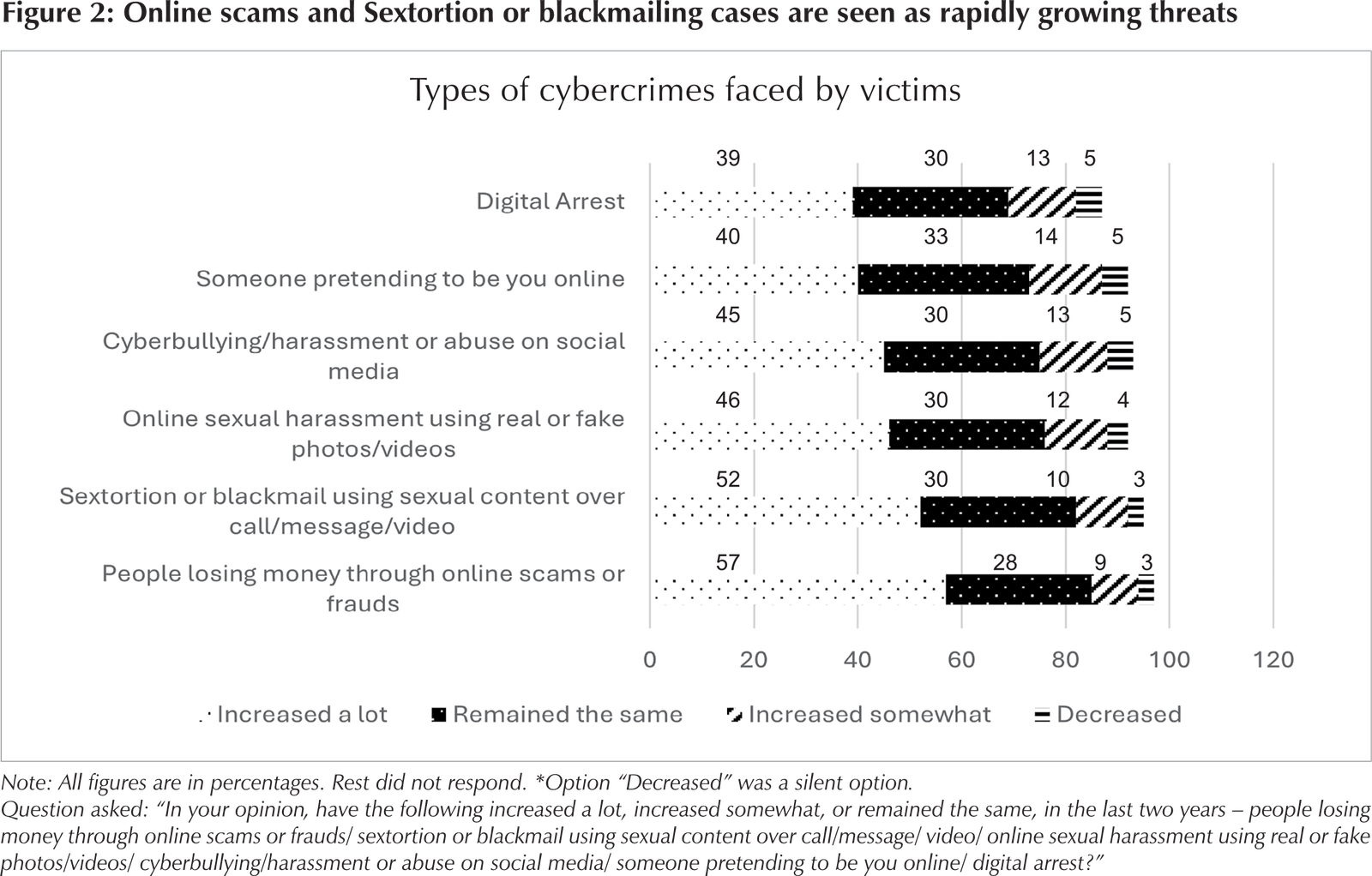
With fear this widespread, we also asked people about their perception on whether cybercrimes have increased a lot, somewhat increased, or remained the same? The majority felt that cybercrimes have increased a lot in the past two years. Almost three in five (57 per cent) felt that people losing money through online scams or frauds has “increased a lot” (Figure 2). Over half (52 per cent) felt that sextortion or blackmail using sexual content has “increased a lot”. Nearly half perceive a strong rise in online sexual harassment (46 per cent) and cyberbullying (45 per cent). Around four in ten see sharp increases in digital arrest scams (39 per cent) and impersonation (40 per cent).
Who are the Victims?
Of the 8,306 respondents, about 13 per cent (1,085 people) had been victims of cybercrime in the past two to three years. For those who weren’t victims, we asked if they had closely helped someone who had been affected by cybercrime, and about 12 per cent (814 people) said that they have done so.
Victims reported higher exposure to fraudulent calls/texts than non-victims (Table 2). Over half (53 per cent) of victims reported receiving a call/text about a product they never ordered, compared to about three in ten (29 per cent) non-victims. A similar pattern was found across all other types of fraud attempts as seen in Table 2.
Table 2: Cybercrime victims report substantially higher exposure to frequent scam calls and messages
| Received a call/text message for | Overall | Victims | Non-victims | |
|---|---|---|---|---|
| Delivery of a product you never ordered | 33 | 53 | 29 | |
| The Phone number has been linked to illegal activities | 23 | 38 | 20 | |
| Bank official asking for personal of account details | 27 | 46 | 23 | |
| An unknown number claiming to be your friend/relative who is in urgent need of money | 23 | 44 | 19 | |
| Investment opportunity, guarantee-ing high return | 31 | 50 | 27 | |
 | Call from police or someone in authority claiming that your friend/ relative is in danger or has commit-ted some crime | 19 | 37 | 16 |
Note: All figures are in percentages. The figures here represent the combined responses of “many times” and “sometimes” categories. The categories of “many times” and “sometimes” have been combined as “frequently”.
Money was the Main Target
Digital financial frauds accounted for over half of the cases (54 per cent), followed by 13 per cent victimised by hacking of devices, one in ten (11 per cent) suffered personal data theft, 7 per cent
by cyberbullying, and 4 per cent by online sexual harassment (Figure 3).
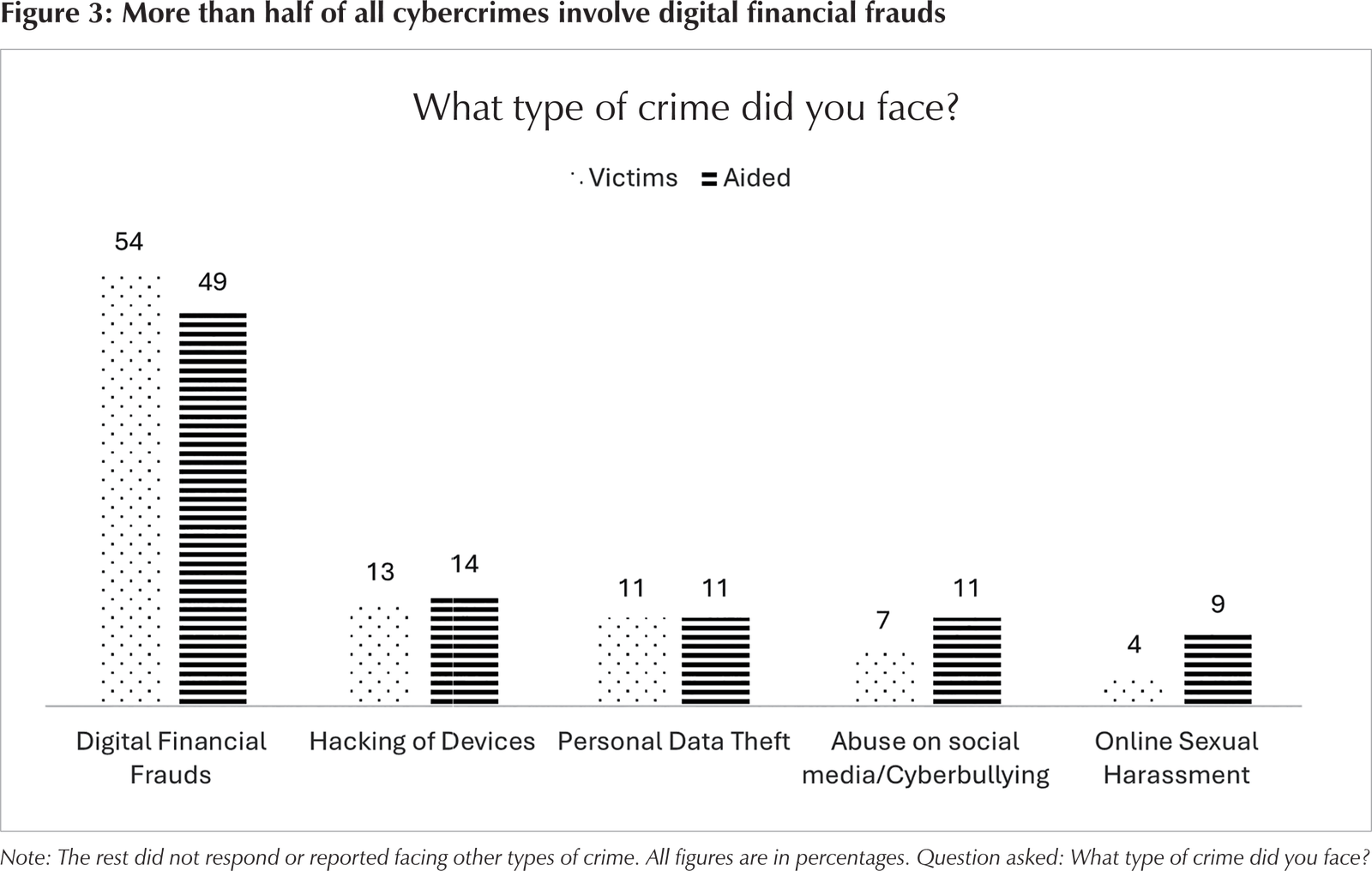
The younger, richer and more educated respondents were the most vulnerable to digital financial frauds. One in six (16 per cent) respondents up to the age of 35 had been a victim of cybercrime, compared to 13 per cent of those aged 36-55 and 8 per cent of those above 56. Across class, 47 per cent of the most economically disadvantaged respondents had been a victim of digital financial fraud, compared to 57 per cent of rich respondents. Across education levels, two in five (40 per cent) non-literate respondents were victims of digital financial frauds, compared to about three in five (59 per cent) college-
educated respondents. It seems that the more access one has to the digital world, the more doors are created for a fraudster to knock on.
A Double-Edged Sword
Put the findings side by side and a pattern is hard to miss. The more people live online – through social media, banking apps and UPI – the more often a fraudster’s call finds them. Victims were far more likely than non-victims to have received such calls (53 per cent against 29 per cent for the fake delivery call, for instance). And the people who might have the most goings on in their digital lives – the younger, the richer and the more educated – were the ones most vulnerable to digital financial fraud.
Fear is keeping pace. Over half of respondents (55 per cent ) highly feared losing money to online fraud. Women feared more than men across every type of cybercrime, and most people believe the problem is getting worse, with almost three in five (57 per cent ) saying that losing money to online scams has
“increased a lot”.
None of this is an argument for logging off. UPI, online banking and e-commerce have made everyday life easier for millions of people. The lesson is subtler: every convenience is also a door, and fraudsters, who are nothing if not inventive, are happy to knock on all of them. The wider the net they cast, the more it matters that someone is minding the doors, whether that is a bank, a platform, the police, or simply a person who pauses before pressing a button.
July September 2026